Case study
Job Studio
An AI career studio, and the decisions underneath it.
- Product
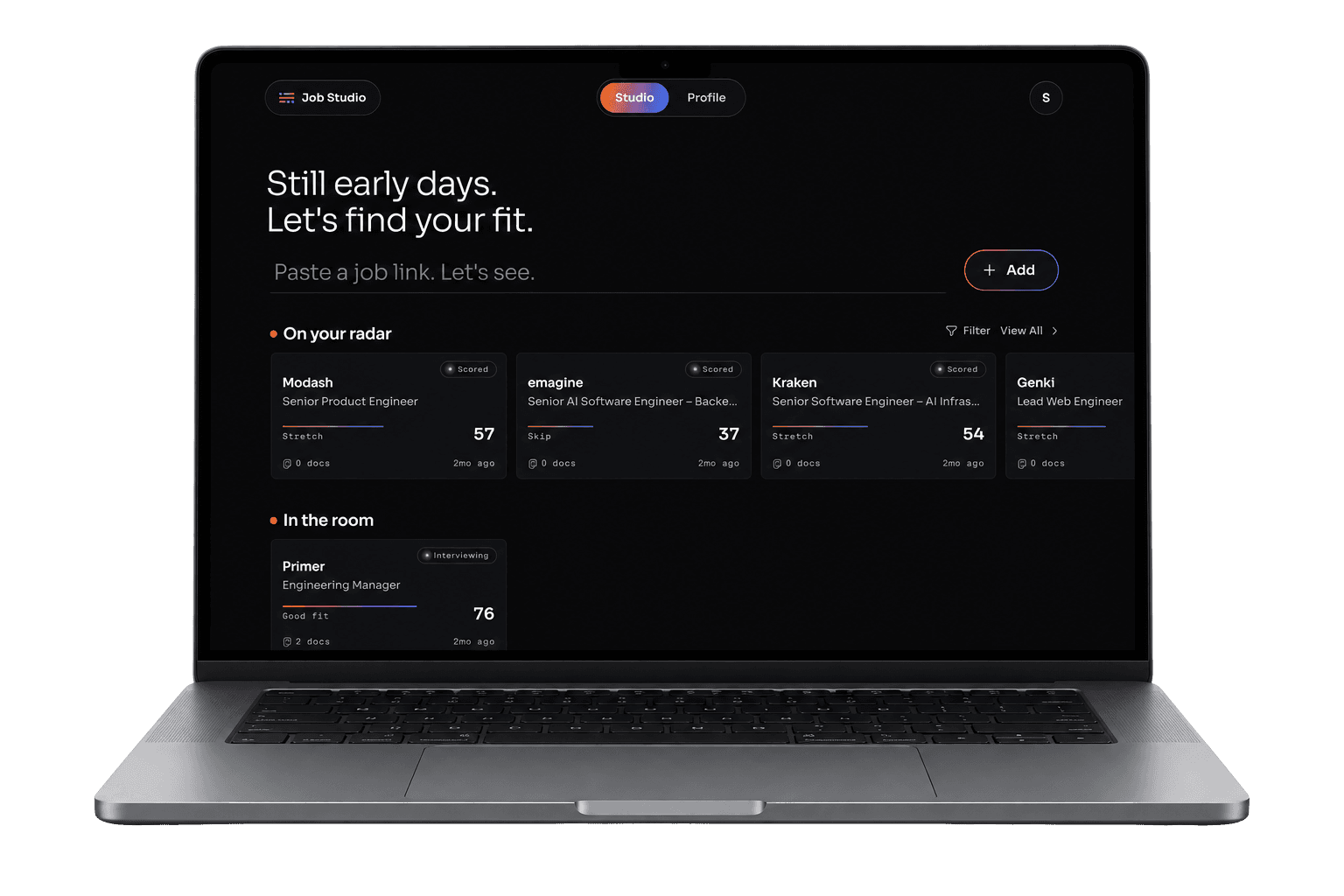
- An AI career studio. Your career in chapters, every job scored against what you want, and applications written only from what's yours.
- Timeline
- In production since July 2026 at job-studio.io.
- Role
- Founder and product lead.
Two problems, pointed at each other
I left a Director of Product seat in April with a list of ideas and nowhere to run them.
That was the first problem. I wanted an agentic platform of my own, somewhere I could put a real idea in one end and get a real answer out the other. A prototype won't hold that. It tells you a thing is possible on a Tuesday afternoon, then falls over the moment anything real touches it. The durable version is the only useful one, and you can't build it against a toy problem, because a toy lets you skip every part that breaks. It has to be real, it has to be hard, and it really helps if it's yours, so you can't quietly walk past the ugly bits and call them solved.
The second problem was the search.
I was looking for my next challenge and I'm particular about what qualifies. Not a title with a salary bolted onto it. Once that's the bar, most of the work stops being applying and starts being deciding. Is this one even worth an evening. That's the real labour of a senior search, and it's the part every piece of advice tells you to skip. Apply to more. Widen the net. It's a numbers game.
When you're picky it's a judgment problem wearing a volume problem's clothes.
And judgment doesn't get faster by staying up later. Within a few weeks the looking had turned into a second job, which is a stupid place to end up. The whole point of searching properly was to find work worth doing. Instead the searching had become the work.
So:
The first problem
a platform with nothing real to prove itself against,
The second problem
and a search quietly eating my evenings.
I pointed one at the other.
So I did it by hand
I had no tool, so I did the job properly.
Setup first. A long session per chapter of my career, pulling out what actually happened in each one until there were a few real pages sitting behind every role. The portfolio. The references. Then a scoring doc for what I wanted next, because I was going to be turning things down and I wanted to know why.
Then, per posting: read the company properly, score it against the doc, build the application from scratch.
Two hours. One thing worth sending. Session burned.
That isn't a shortcut and it isn't a hack. It's what you'd do if you had the time.
Doing it slowly is what broke it into parts. Each of these was its own failure, and each one became a piece of the build.
The process, and where it broke
0h 2h
Setup
Broke
Résumé ≠ inventory.
It's a lossy summary of a career. You can't tailor from a summary, and getting the real material back out takes rounds of questions, not one upload.
Broke
One thread, averaged.
I was doing this with an AI in one long session. It had everything, which meant it had nothing sharp. Ask about one role and you get the average of all of them.
Read the company
Broke
Who am I writing to?
Employer research done properly is the part that eats the evening before a word gets written.
Broke
Same research, again.
Per posting, from zero, forever.
Score it
Build the application
Broke
Nothing compounds.
Every application starts cold. What I worked out for one posting didn't carry to the next, and nothing held the shape of everything I'd already applied to.
Send
Broke
Lost track.
The history lived in dead sessions and my memory, which is not a system.
The turn
It took a while to see the pattern, and it's the whole reason there's a product.
Knowing me was never the problem. Every job was the problem.
Then I checked whether it was just me
One person's wasted evenings are not a market. So I went and looked, and the order matters: I lived it first, and the real research landed in June, after the build had started. It confirmed an instinct. It didn't cause the product.
What I didn't expect was that the market had already split into two camps, and both of them lose.
One camp automates the sending. The case everyone cites is one job seeker who fired five thousand applications through an auto-applier and got twenty interviews back. The other camp tracks. Beautiful boards, nothing generated, the work still yours at eleven at night.
A line from a Hacker News thread about the first camp is the one that settled it for me. If enough people do it, everyone's chances go to zero.
Camp one · loses
Automates the sending
Five thousand applications. Twenty interviews back.
Camp two · loses
Tracks
Nothing generated, the work still yours at eleven at night.
The gap
The judgment answer
Nobody was building it.
That's a market where the volume answer is structurally dead.Which leaves the judgment answer, and nobody was building it.
68.5 days
median time to a first offer, across 461,000 tracked applications. Huntr, Q2 2025. Up 22 percent.
39% less likely
the people sending the most applications are the least likely to get a positive reply. Indeed.
62% of employers
reject an AI-generated résumé that was not personalised. Resume Now, survey of 925 HR workers.
Then people asked me to build it
I built it for one user. Me. The first career history in the product is my own, and it went in while I was actually applying for jobs.
That's the only reason the early decisions were worth anything. You don't build a chapter model and an enrichment loop for a user you invented. You build it because you hit the wall yourself on a Tuesday and you're annoyed about it.
Then I showed it to friends. They used it, and they asked me to build it properly.
That's where it stopped being mine, and where the job got a lot harder. A tool built around one career works partly because it inherited that person's context for free. Hand it to someone else and every assumption you didn't know you'd made comes off the wall at once.
The line I wouldn't cross
One rule was set before any of this and it never moved.
Automate the work, never the decision.
The work
- the reading,
- the research,
- the drafting,
- the remembering.
All of that is mine to take off you.
The decision
- whether a job is worth your evening,
- and whether what goes out has your name on it honestly.
That stays yours.
So the product will not apply for you. Not as a missing feature, not as a later roadmap item. You send it by hand or you don't send it. People ask for it and the answer is no, because the moment a machine is pressing send you're back in the camp where everyone's chances go to zero.
Then it met careers that weren't mine
Building it for myself was easy in a way I didn't notice until it stopped being true. I knew my own career, so the tool didn't have to. Then other people's histories arrived and three things broke at once.
One career doesn't fit one page.
Fifteen years read flat comes out as an average. The parts worth hiring someone for are exactly the parts an average removes.
Translation isn't keyword matching.
Moving a career across an industry means finding what the work actually was, underneath the words it got written in. Every tool on the market matches strings and calls that translation.
A system that can invent an achievement is worse than no system.
If your name is going on it, a confident lie isn't a small bug. It's the product failing in the one way you don't recover from.
Everything after this is what I did about those three.
What the mess forced
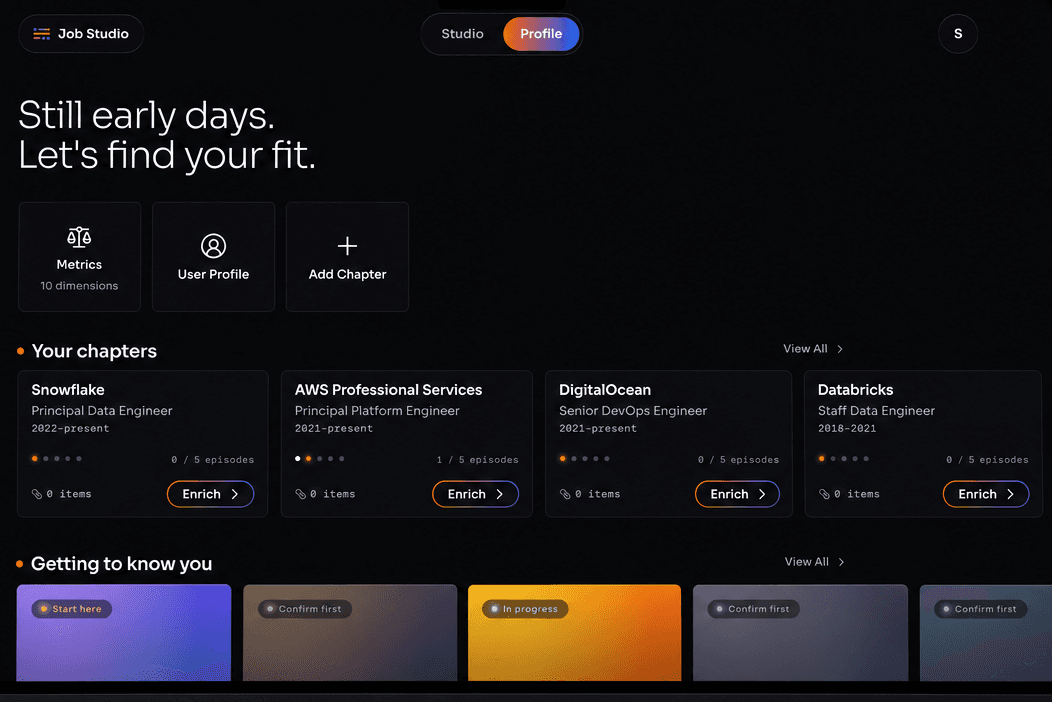
A career becomes chapters, and each chapter gets its own expert.
One reader holding a whole history writes it flat, and flat is where the hireable parts go to die. So the career gets split, and each stretch gets a specialist that knows that stretch and nothing else. Ask about one role and you get something that lived in it, not the average of everywhere you've worked.
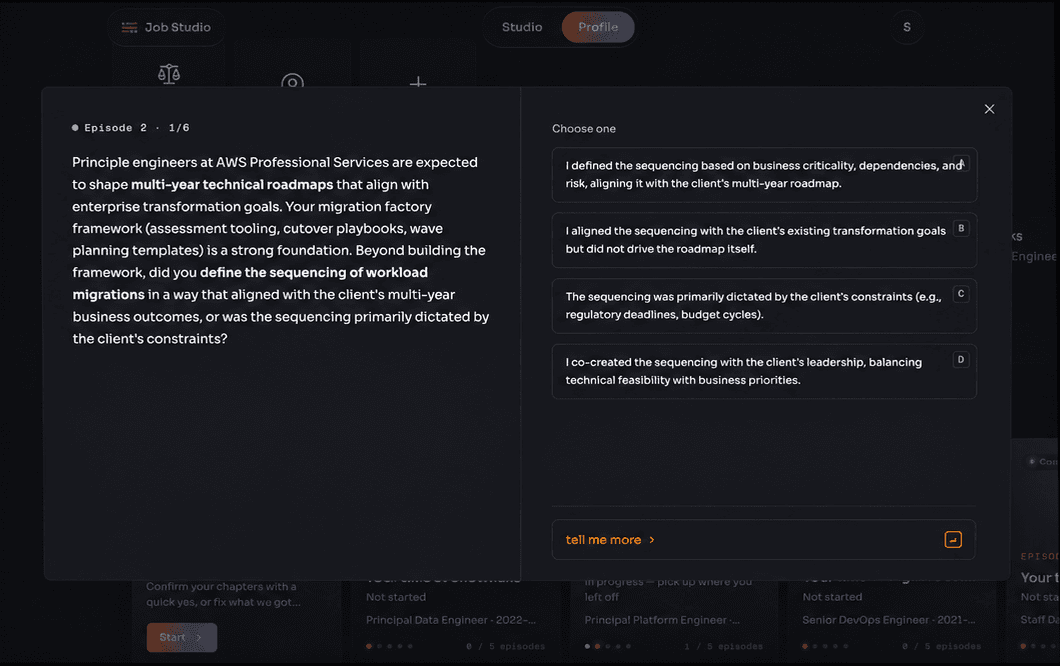
The product asks you questions.
A résumé is a summary and you can't tailor from a summary. So the upload isn't treated as the truth, it's treated as the opening bid, and then the product goes back for what the résumé never had room for. Each round makes that chapter denser. Yours gets better the more you use it, which is the opposite of how everything else in this market behaves.
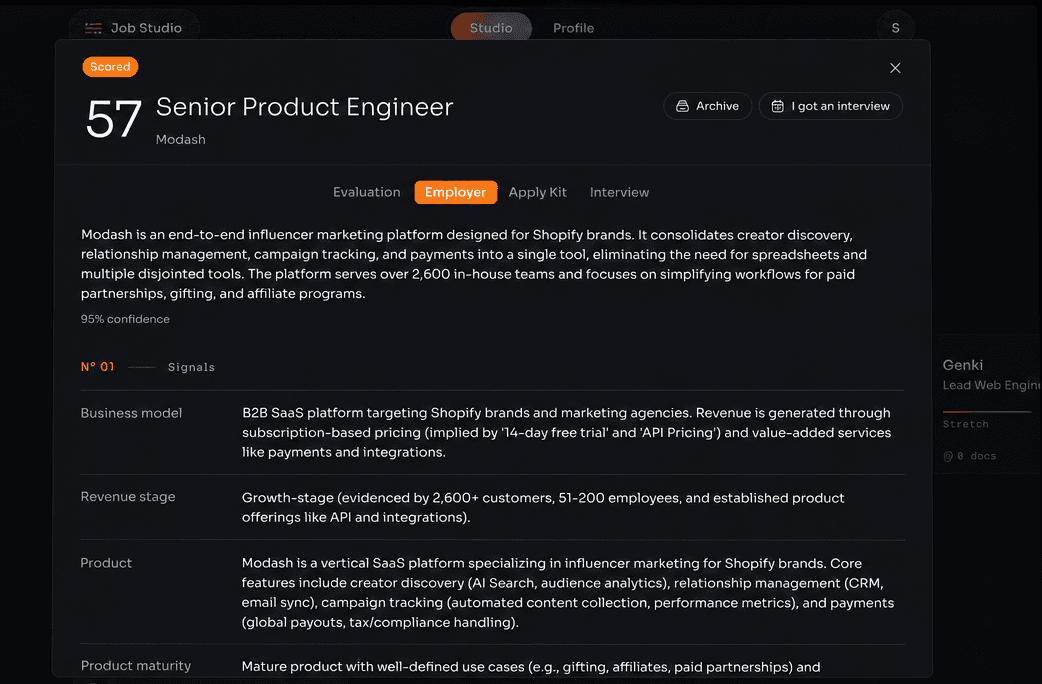
Researching the employer is its own job, not a paragraph in the writing step.
The most expensive hour of doing this by hand was working out who I was writing to. So it runs first, on its own, with its own output, before a word of the application exists.
The call most people don't know they're making
If you're building anything that reasons over a person's history, there's a default. Chunk the documents, embed them, search for what's similar. Nearly every AI product you've used is doing that. It works, it's cheap, and it's the answer that arrives before the question does.
I built that. Then I watched it fail at the only thing that mattered.
Similarity answers what else looks like this. The question a career actually asks is how does this connect to that. Running a team is running a team whether the room was a classroom, a kitchen or a product org, and something that only knows what looks similar will never make that jump, because those words don't look similar at all. They're the same shape. Shape isn't something you get from the distance between two vectors.
Similarity
what else looks like this
Those words don't look similar at all
Shape
how does this connect to that
They're the same shape
So the brain became a graph. Facts, the connections between them held as real connections, and the whole thing compiling as you use it instead of starting cold at every application.
The part that took longer to see: I'd been using one word, knowledge base, for two completely different jobs. One is holding what's true about you, verbatim and durable, in a form you can hand back. The other is reasoning over it. Those were never the same system.
So the product runs both, deliberately. A source of truth that holds your career exactly as it is, and a graph above it that does the thinking and can be thrown away and rebuilt. The flat store in the middle, the one everybody starts with, was decommissioned. Nothing reasons over it now.
The rule underneath is small and I'd hold it on any product.
Never let the thing that thinks be the only copy of the thing that's true.
The sharp edge
One more call inside that one, and it's the one I'd want to be judged on.
Each chapter's expert has to know only its own chapter, or it will start talking confidently about a job you never had. The obvious fix is to give every expert its own separate store. It's also wrong, because the moment you cut a career into separate stores you destroy every connection between them, and the connections were the whole point.
So:
one graph, so the connections can exist.
Hard walls at retrieval, so an expert cannot reach a role it didn't live.
And the cross-chapter thinking happens one level up, in the thing whose job is to see the whole career at once.
Take either easy road and you lose something you don't get back.
Partition the storage
and you lose the translation.
Soften the walls
and you lose the trust.
How a score gets to be yours
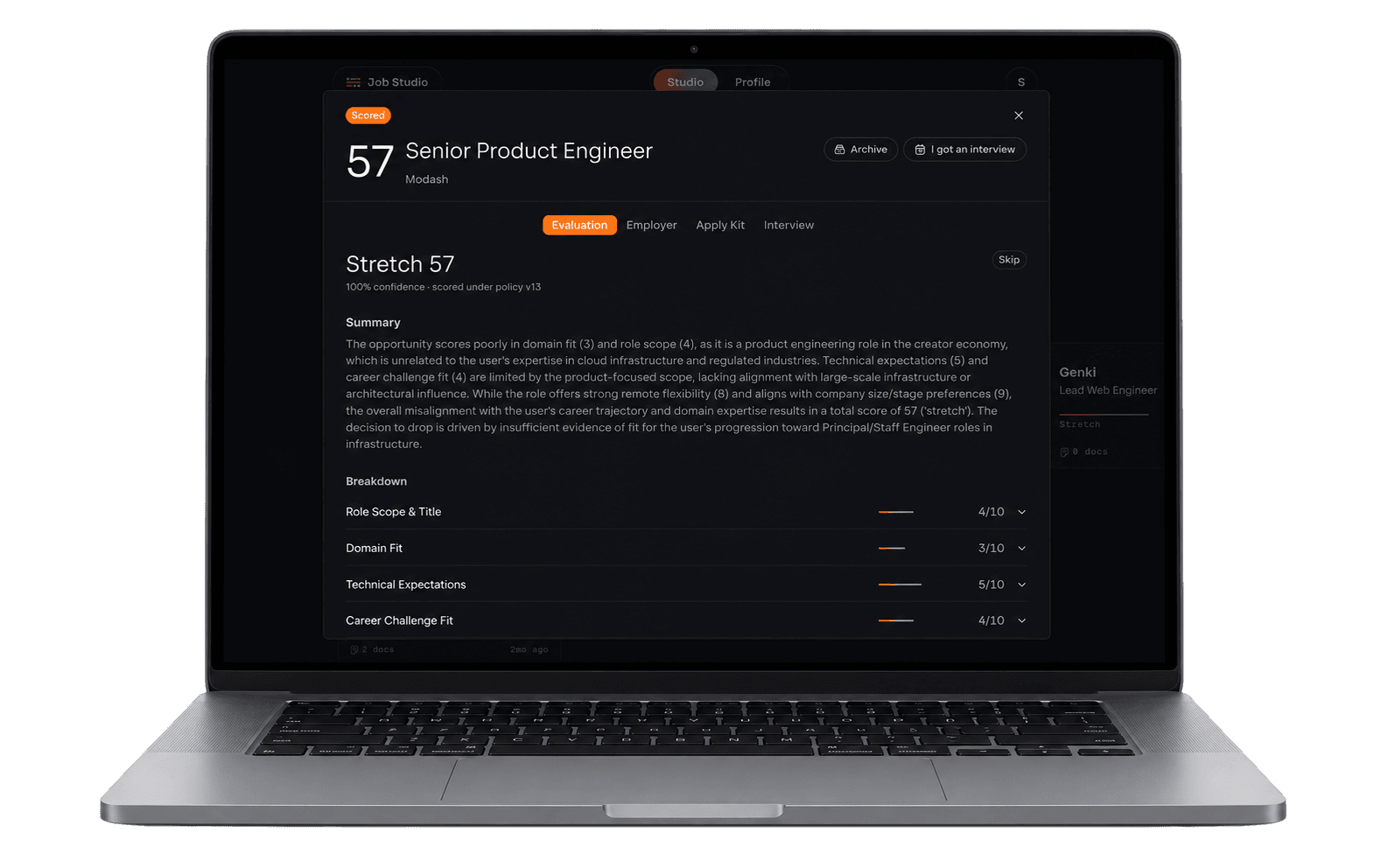
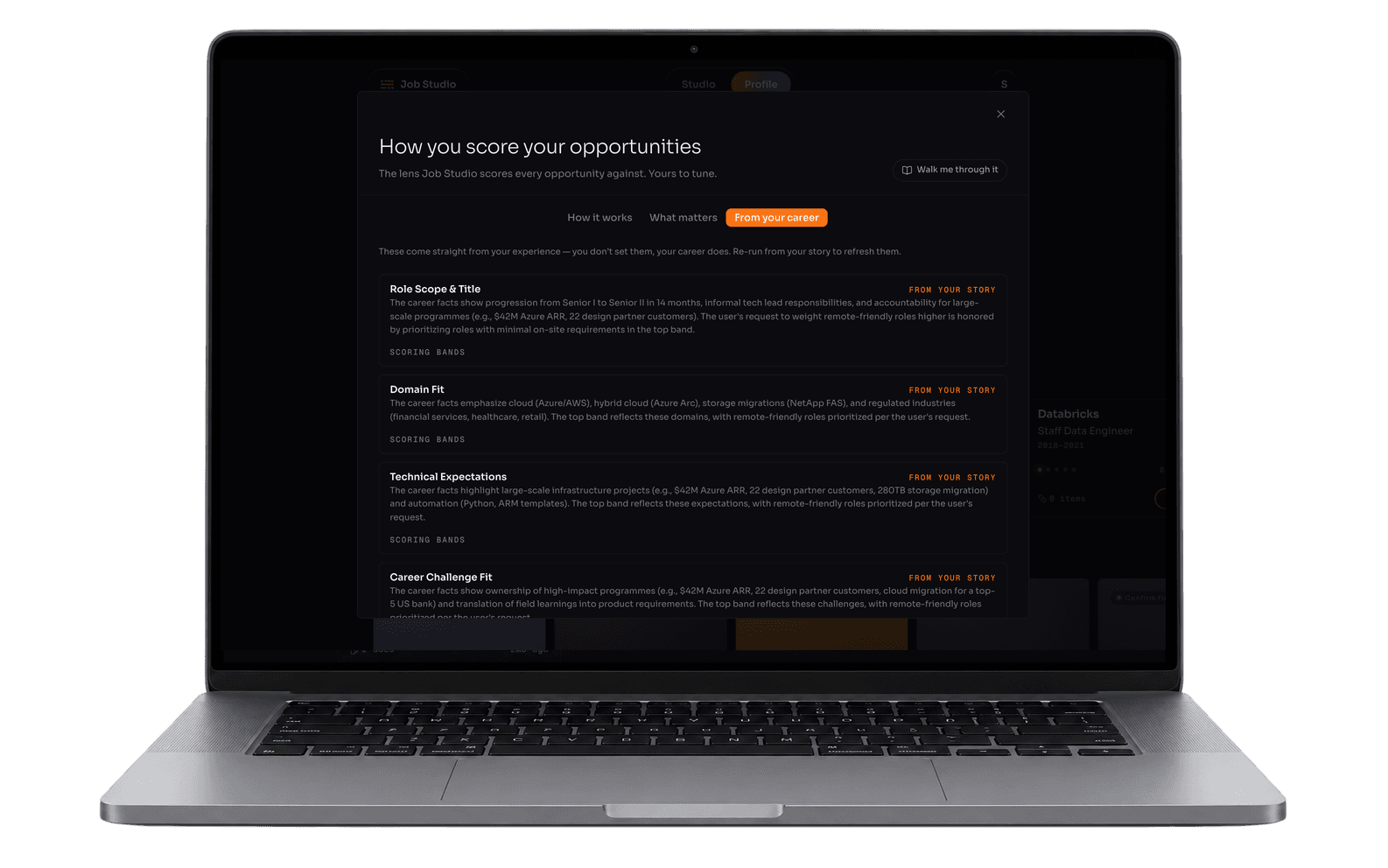
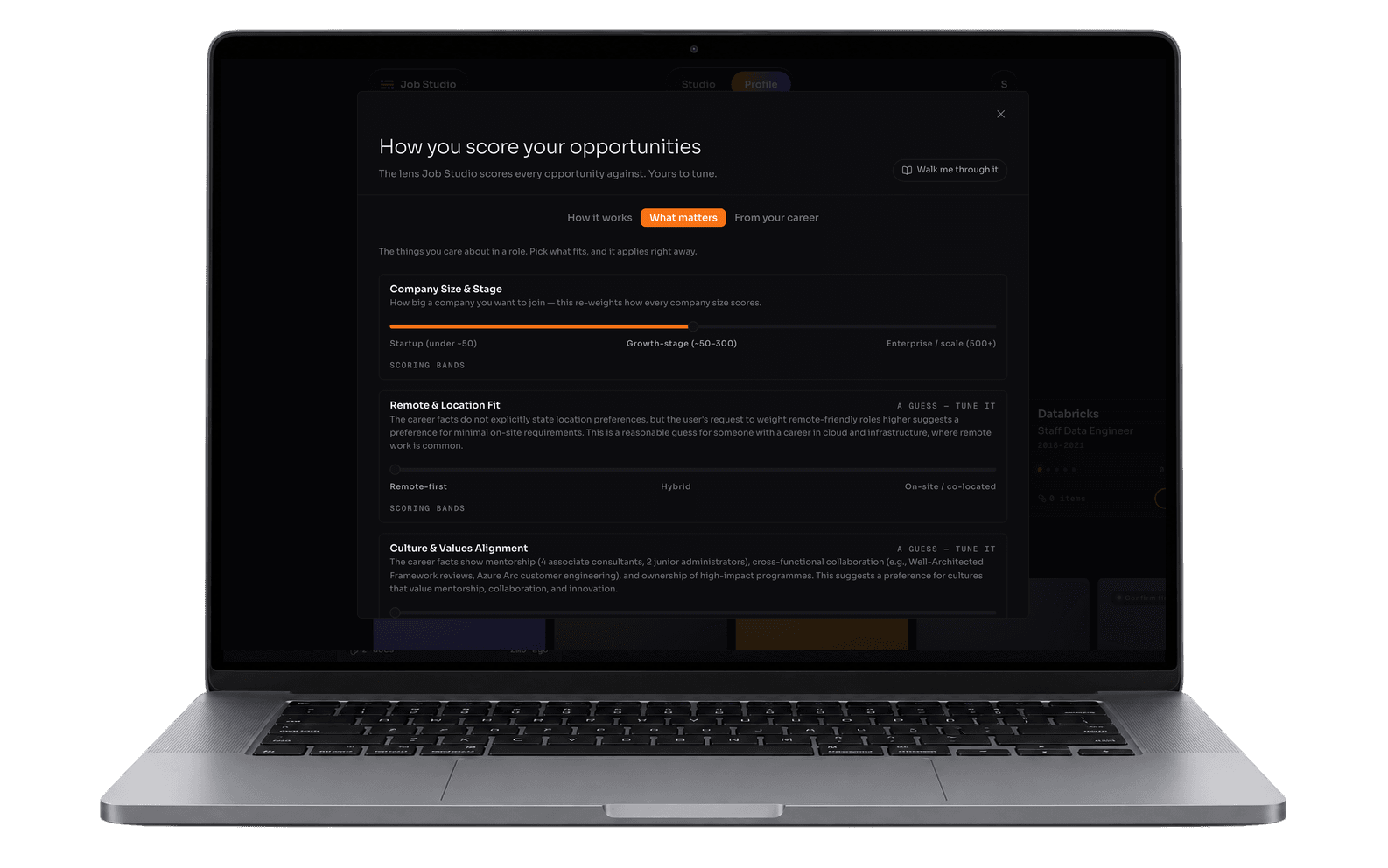
What makes a job good isn't the same for two people, so a fixed set of criteria is just somebody else's opinion applied to your life. The dimensions can be shared. Scope, growth, compensation, how remote it is, what the culture is like. What can't be shared is where the lines sit inside them.
So the lines get read off your own career. What counts as a step up for you is set by where you've actually been, not by a table someone wrote once. Most of the dimensions are universal and one of them is chosen specifically for you, because there's always something that matters to a particular person that no fixed list is going to contain.
Some of that is grounded in what your history actually says. Some of it is inferred, because a résumé doesn't tell anyone what you want from the next job. The product marks which is which, so you can see exactly where it guessed, and change it.
Then it scores against a bar you set. Not one we set.
Find the layer before you pay
Something started describing a job it had never been given, which is the exact failure the architecture exists to prevent. The reflex answer, and the one most teams reach for, is a bigger model.
I proved the walls first. Retrieval got tested live, nothing reached out of its own chapter, and a control run with the walls dropped showed those other facts sitting right there to be pulled. So the isolation held and the model lied anyway, which is a different problem at a different price. I rewrote the instruction and the cheap model held. The bigger model would have billed every month and fixed the wrong layer.
The reflex
A bigger model
Billed every month. Fixed the wrong layer.
Find the layer
- Prove the walls.
- The isolation held.
- Rewrite the instruction.
- The cheap model held.
None of that is on screen
Everything above this is invisible.
You upload a résumé. It comes back as chapters, one per stretch of your career, each with a few questions waiting on it. You answer the ones you feel like answering and the chapters get better. You paste a job link and you get a number, a short read on why, and a breakdown you can argue with.
That's the product.
On screen
- Chapters,
- questions,
- a score.
Not on screen
There's no graph on screen. No agents, no workflows, nothing named after a model, no tier to pick, no settings page where you choose how clever you'd like today to be. Two different depths of analysis run underneath and they have internal names no user will ever see, because the name of the machine isn't a feature, it's an admission.
This is the part I'd argue hardest for. Plenty of AI products show you the machinery working and sell it as transparency. Usually it's the reverse. A product narrating its own agents at you is spreading the responsibility around, so that when the output is wrong, you were technically watching.
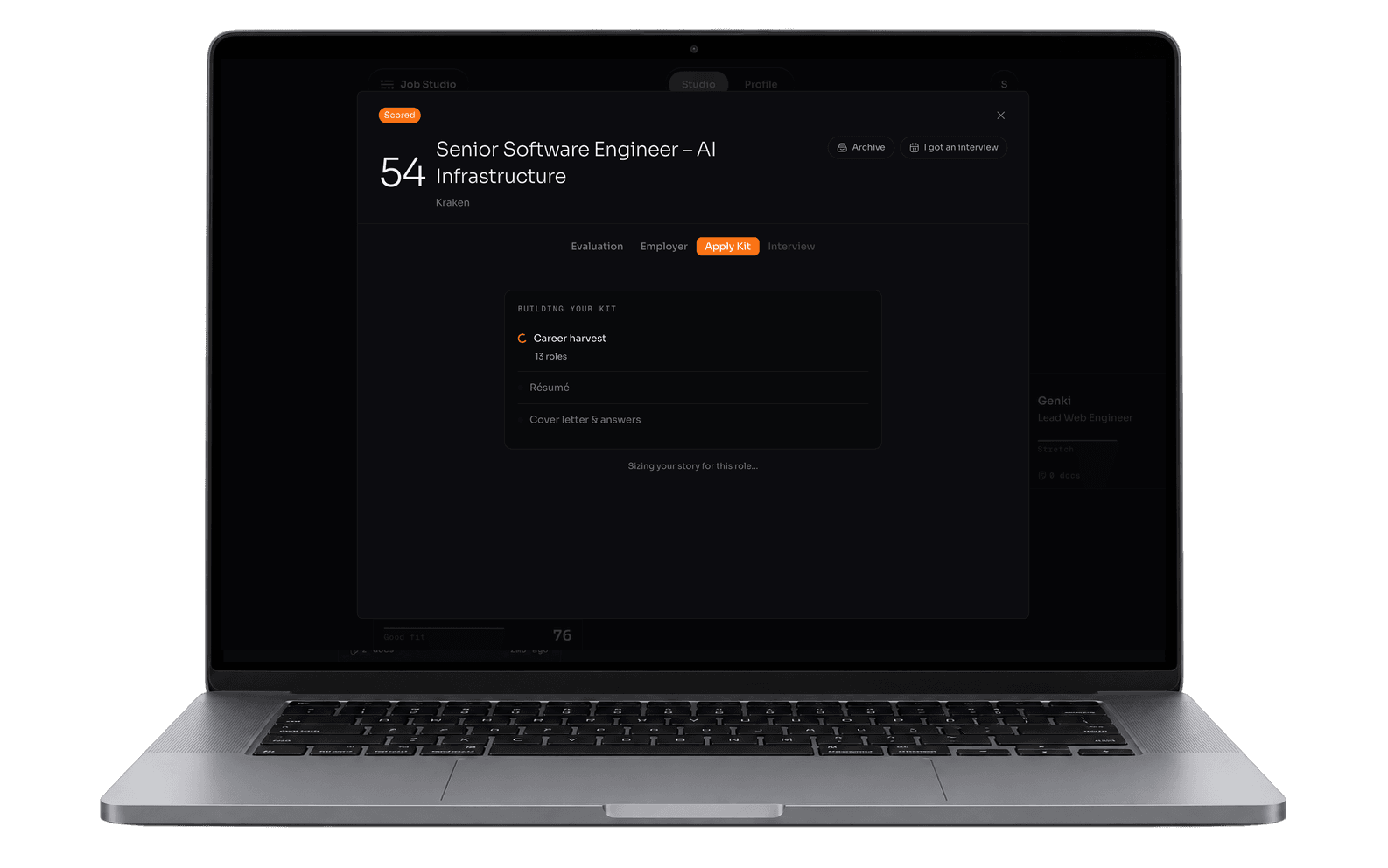
If the thing works you shouldn't have to watch it work. Chapters, questions, a score. Everything else is my problem.
Watch it run
- A job link goes in
- Employer research
- A score with its reasoning
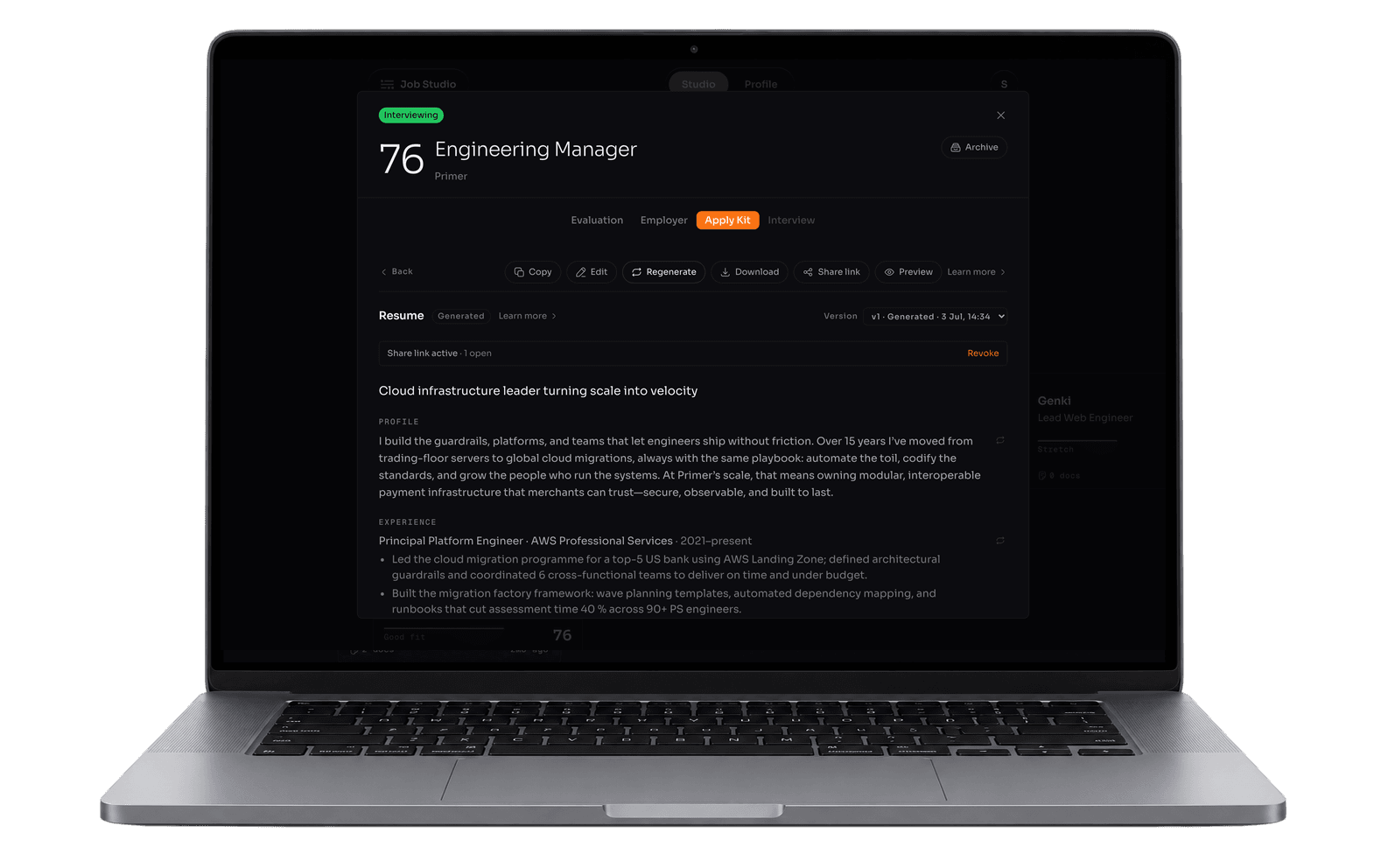
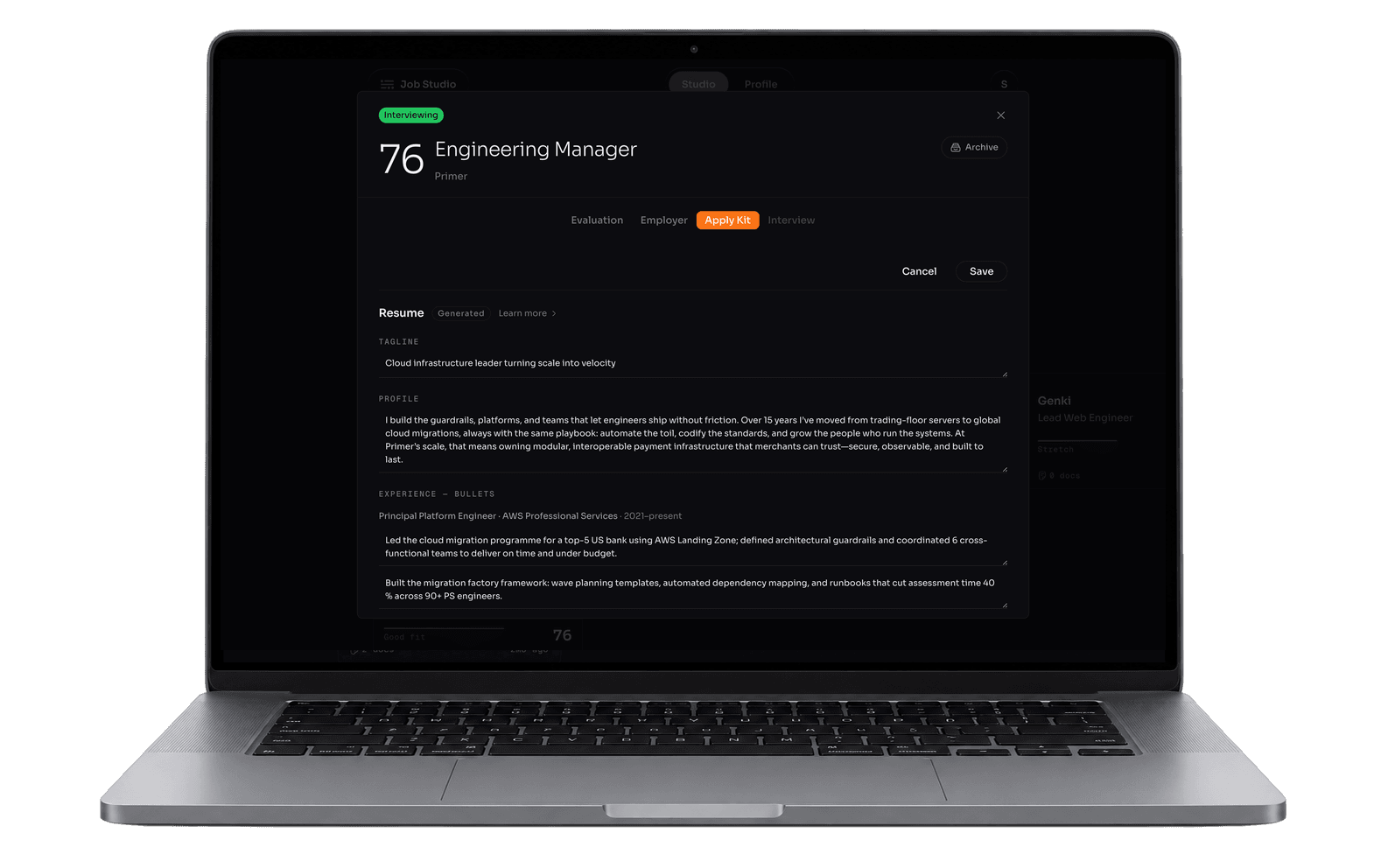
- A résumé, written and edited
This is what the studio does.
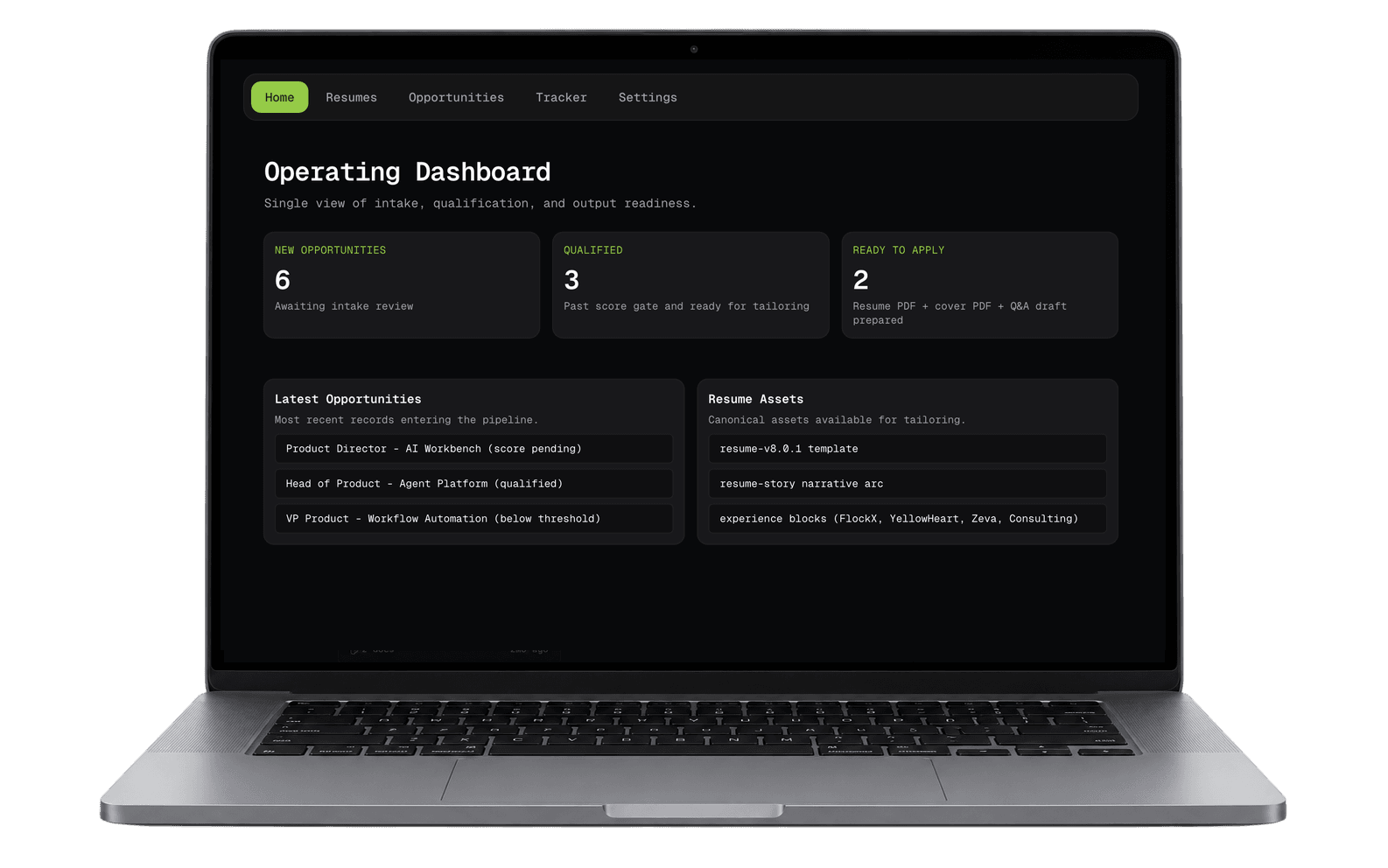
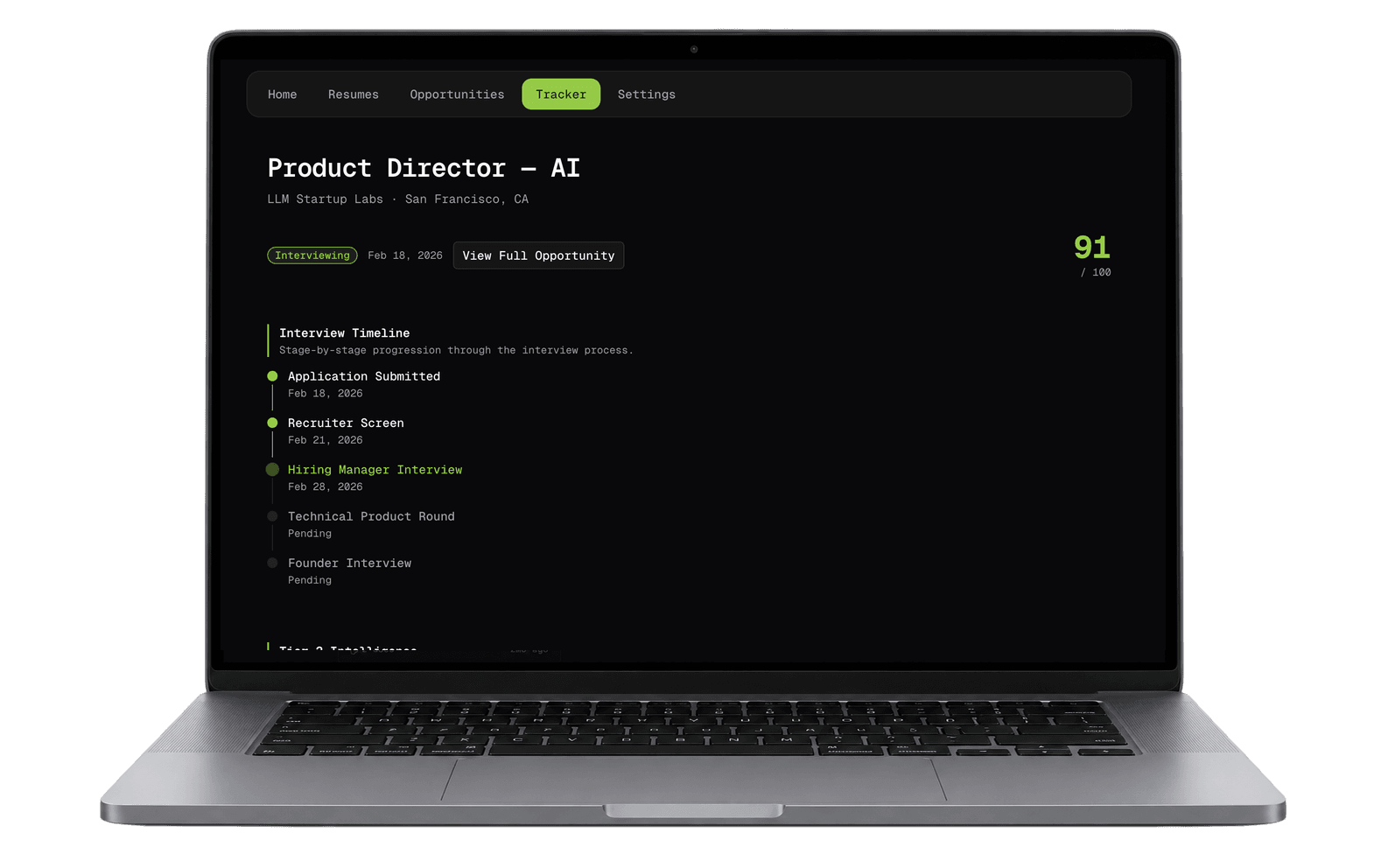
A job link goes in. Employer research comes back, then a score with its reasoning, then a résumé written against that chapter and edited.
It's live at job-studio.io.
One thing I've kept back until now, because it changes how all of this reads.
I built it alone.
I don't write the code, I direct AI teams that do. Which means every decision on this page was bounded by the same question: can one person still own this in six months. That's why there are two stores and not five, and why the surface asks you for nothing.
If you're building with AI and you've hit the part where it has to still work on Tuesday, that's the conversation I want.
Tell me what's breaking
One reply, from me, no sequence.